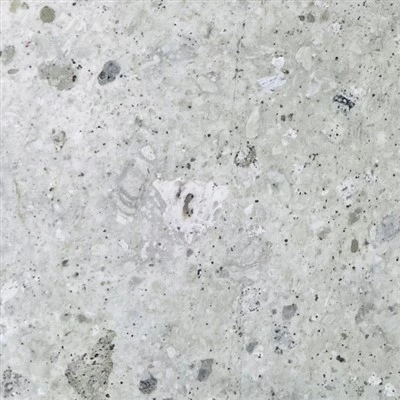
The main component of limestone is CaCO3, which exists in nature as calcite and aragonite. Calcite belongs to the trigonal crystal system, hexagonal crystal, pure calcite is colorless and transparent, generally white, containing 56% CaO, 44% CO2, density of 2.715g/cm3, Mohs hardness of 3, and it is relatively brittle. Aragonite belongs to the orthorhombic strain, rhombic crystals, gray or white, with a density of 2.94g/cm3, a Mohs hardness of 3.5-4, and a dense nature.
The crystal size of calcite is very important in the physical properties of limestone. Dense limestone exhibits a fine-grained crystal structure with low porosity and high strength. The density of limestone is about 2.65-2.80g/cm3, the density of dolomite limestone is 2.70-2.90g/cm3, and the density of dolomite is 2.85-2.95g/cm3. The volume density depends on the porosity.
Thermal expansion of limestone: According to data, the average thermal expansion coefficient of microcrystalline limestone is (4.5~5.0)*10^(-6)/°C, while the average thermal expansion coefficient of microcrystalline limestone increases to 10.1*10 within the range of limestone below 800℃. ^(-6)/℃. The heating experiment of limestone has a very important meaning in lime production. The limestone crystals expand at 800°C below the decomposition point of limestone, and cracks are formed in the highly crystallized limestone, and those larger crystals will be broken into powder by heating, which is good for crystal growth and contains a lot of Limestone pulverization of dense calcite is more serious.